Cañon City Housing
Needs Assessment
Update + Strategic Growth Element
Experience That Builds Better Complete Streets
Cañon City’s Housing Needs Assessment and Strategic Growth Element present an opportunity to do more than satisfy new State planning requirements. Together, they can provide a clearer understanding of what housing the community needs, where opportunities exist to accommodate that need, what barriers stand in the way, and how future growth can be aligned with infrastructure, community priorities, and available resources.
Bohannan Huston (BHI) has assembled a team that combines housing analytics, community and land use planning, GIS and spatial analysis, infrastructure expertise, engagement, and strategic growth planning. Our approach builds from work Cañon City has already completed while introducing new analytical tools and planning methods that can help turn data into practical decisions.
The result is an integrated process:

The Right Expertise at the Right Step
No single tool or discipline can answer Cañon City’s housing and growth questions. Our team is intentionally structured so that each partner contributes where they add the greatest value: My Town AI establishes a rigorous housing-analysis foundation; BHI connects those findings to local context, engagement, land use, infrastructure, and implementation; and MIG adds national strategic-growth and comprehensive-planning perspective to help shape the Strategic Growth Element.

Connecting Housing Need to Place
Housing need doesn’t occur independently of land use, infrastructure, regulations, or geography. BHI brings those pieces together.
Our planners, GIS specialists, and infrastructure professionals have helped Colorado communities assess housing needs, update comprehensive plans and development regulations, evaluate development capacity and constraints, and translate planning recommendations into implementable policies and investments.
For Cañon City, BHI will provide the bridge between the HNA and Strategic Growth Element – connecting how much and what type of housing is needed with questions of where that growth can occur, what constraints affect it, what infrastructure is required, and what policy choices can make desired growth more achievable.

Better Planning, Not Just Faster Analysis
BHI’s relationship with Nichole Sterling and MyTown AI predates this opportunity. Over the past several months, BHI Project Manager Derrick Webb and Nichole have been exploring a shared question: How can emerging analytical tools help us become better planners—not simply faster planners?
That collaboration pairs MyTown’s purpose-built housing analytics with BHI’s planning judgment, engagement, local context, and implementation expertise. MyTown can efficiently organize, analyze, and document the data needed to understand local housing conditions and projected needs. BHI then uses that analytical foundation to ask better questions, engage the community, interpret what the findings mean locally, and connect demonstrated housing needs to practical policy and growth decisions.
For Cañon City, that means technology is not replacing the planning process—it is creating more capacity for the parts of planning that require local knowledge, professional judgment, community conversation, and creative problem-solving.
MyTown builds the analytical foundation. BHI turns the findings into planning decisions.

Adding Perspective to the Strategic Growth Conversation
BHI is also partnering with MIG to support development of Cañon City’s Strategic Growth Element. MIG brings broad experience in community planning, land use, urban design, and development of planning frameworks that help communities translate long-term vision into decisions about growth and investment.
Working alongside BHI, MIG will provide additional strategic planning perspective as the team evaluates Cañon City’s existing growth framework, infill and redevelopment opportunities, future growth areas, and the policy choices needed to support compact, serviceable, and fiscally responsible development.
BHI will lead the local land use, GIS/suitability, infrastructure, and integration work, while MIG will help challenge assumptions, frame meaningful growth choices, and strengthen the policy framework that emerges from the analysis.
Together, the team can move beyond simply identifying where growth could occur to help Cañon City consider a more important question:
Where should growth occur—and what needs to happen to make that growth successful?
See the Housing Analysis in Action
A quick look at My Town AI’s housing analysis tools applied in Nederland, Colorado. This brief walkthrough demonstrates how the platform organizes community-specific housing data and helps establish the analytical foundation for a Housing Needs Assessment, creating more capacity for the planning team to focus on interpretation, community context, engagement, and actionable recommendations.
Watch the brief walkthrough below.

Housing Needs Assessment | Town of Nederland, CO
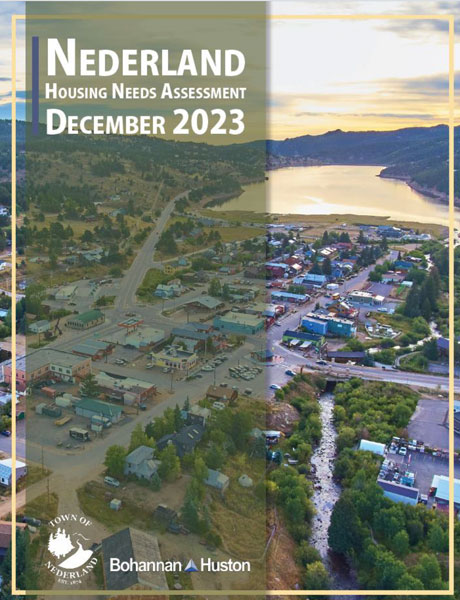
Key Features
- Comprehensive assessment of current and future housing needs
- Built upon and updated previous community housing studies
- Demographic, household, housing supply, and market analysis
- Evaluation of housing needs, supply gaps, and affordability challenges
- Community and stakeholder engagement integrated with technical findings
- Housing preservation strategies and identification of future housing opportunities
- Policy and regulatory recommendations supporting implementation
- Supported eligibility for Colorado affordable housing funding programs
Housing Needs Assessment | Town of Lyons, CO

Key Features
- Updated an earlier community Housing Needs Assessment to reflect changing conditions
- Analysis of demographic, household, housing, and affordability trends
- Evaluation of increasing housing costs and attainable housing needs
- Assessment of current and future housing needs and supply gaps
- Community engagement used to validate and provide context for quantitative findings
- Strategies addressing housing preservation and expansion
- Policy and regulatory recommendations tied to identified housing needs
Housing Needs Assessment | Gilpin County, CO
Key Features
- Countywide assessment of existing and future housing needs
- Population, household, employment, and housing-market analysis
- Evaluation of the relationship between local employment and housing availability
- Coordination with Central City and Black Hawk to understand countywide conditions
- Assessment of geographic, zoning, infrastructure, and development constraints
- Identification of barriers affecting housing production and availability
- Policy and program recommendations responsive to rural and mountain-community conditions
ADU Policy + Implementation | Town of Center, CO
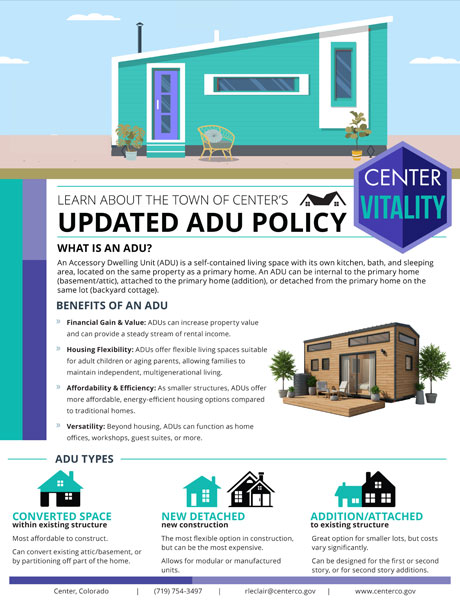
Key Features
- Translation of housing policy objectives into implementable local regulations
- Evaluation of local barriers to accessory dwelling unit development
- Development of an ADU policy framework responsive to updated Colorado requirements
- Preparation of adoption-ready ordinance language
- Development of administrative procedures and application materials
- Public-facing and bilingual materials supporting community understanding
- Integration of housing policy with day-to-day development review and implementation
City of Santa Fe Street Design Guide | Santa Fe, NM

Key Features
- Context-sensitive street design guidance balancing safety, mobility, and community character.
- Multimodal design standards supporting pedestrians, bicyclists, transit, and vehicles.
- Policy framework connecting engineering standards with community planning objectives.
- User-friendly document supporting long-term implementation and consistent decision-making.
Firestone Transportation Master Plan | Firestone, CO

Key Features
- Long-range transportation planning supporting continued residential and commercial growth.
- Multimodal transportation recommendations integrated with future land use planning.
- Coordination of roadway improvements, trail connections, and mobility enhancements.
- Implementation roadmap identifying phased transportation investments.
PACOG 2050 Long Range Transportation Plan | Pueblo County, CO
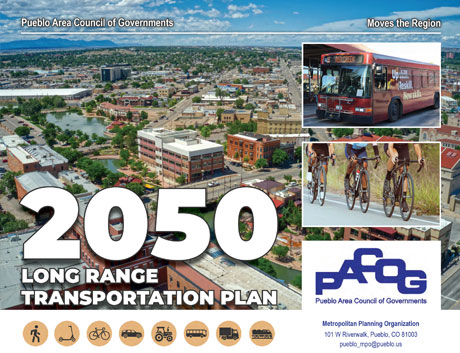
Key Features
- Regional long-range transportation plan integrating mobility, safety, resiliency, environmental stewardship, and economic development.
- Data-driven prioritization reducing a large universe of projects into a focused, implementable investment strategy.
- High-quality graphics, mapping, and visual communication supporting decision-makers and the public.
- Action-oriented implementation program connecting planning priorities with funding opportunities and project delivery.
Grand Valley Regional Transportation Plan | Grand Valley, CO

Key Features
- Regional transportation planning coordinating multiple jurisdictions and partner agencies.
- Long-range investment strategy balancing mobility, safety, and economic development.
- Integration of transportation planning with land use, growth, and infrastructure considerations.
- Prioritized implementation program supporting future funding decisions.
Gallup Comprehensive Safety Action Plan | Gallup, NM

Key Features
- Comprehensive multimodal transportation safety planning aligned with Safe Streets and Roads for All (SS4A).
- Extensive stakeholder coordination with local agencies, tribal partners, and community organizations.
- GIS-based safety analysis and data-driven project prioritization.
- Implementation strategy connecting planning recommendations with future funding opportunities.
Cortez Comprehensive Safety Action Plan | Cortez, CO

Key Features
- Community-driven transportation safety planning focused on implementation and project delivery.
- Integration of roadway, bicycle, pedestrian, and accessibility improvements.
- Data-informed prioritization supported by GIS analysis with the development of a High-Risk Network.
- Clear implementation framework linking projects to funding and capital improvements.
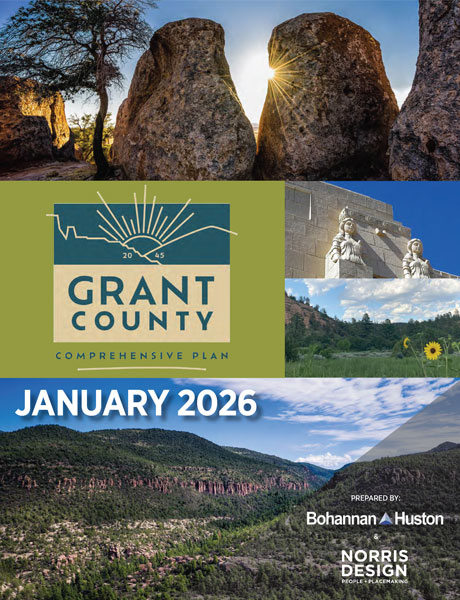
Grant County Comprehensive Plan | Grant County, NM
Key Features
- Countywide Comprehensive Plan integrating housing, transportation, infrastructure, economic development, and resilience.
- Extensive public and stakeholder engagement informing long-range policy development.
- Future land use planning supported by implementation-focused goals and strategies.
- Modern, graphically rich document designed to support long-term decision-making.
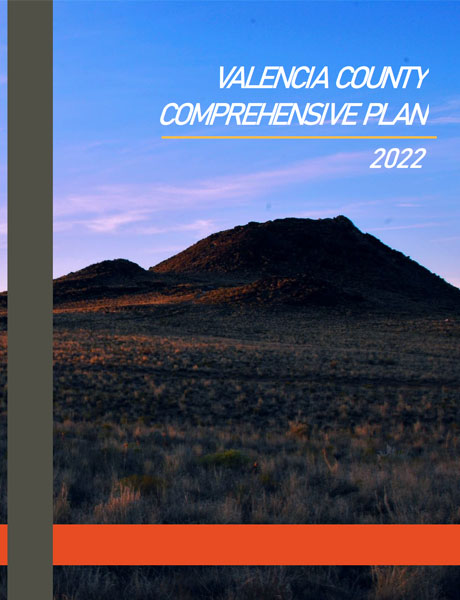
Comprehensive Plan Update | Valencia County, NM
Key Features
- Countywide Comprehensive Plan update integrating land use, infrastructure, economic development, and community resiliency.
- Extensive stakeholder and community engagement across diverse jurisdictions and rural communities.
- Growth management strategies balancing development, agriculture, and natural resource preservation.
- Action-oriented implementation framework with measurable priorities and funding strategies.
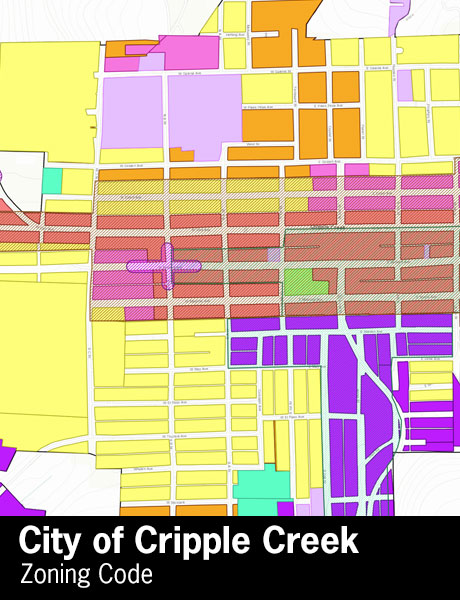
On-Call Planning & Engineering Services | City of Cripple Creek, CO
Key Features
- Ongoing planning and engineering partnership supporting transportation, infrastructure, parks, drainage, and downtown improvements.
- Transportation-related projects including pedestrian improvements, Highway 67 crossing evaluation, wayfinding planning, pavement inventories, and accessibility improvements.
- Historic mountain community experience within the Victor–Cripple Creek Mining District.
- Integration of planning, engineering, grant assistance, and implementation support through an on-call relationship.
Asset Management Plan | Town of Cedaredge, NM

Key Features
- Community-wide roadway and infrastructure inventory supported by RoadAI technology.
- Integration of pavement conditions, utility infrastructure, and capital planning.
- GIS-based asset management supporting long-term investment decisions.
- Practical implementation strategy focused on maintenance, prioritization, and infrastructure coordination.